
Scientific Name
Ara glaucogularis
Kingdom: Animalia
Phylum: Chordata
Class: Aves
Order: Psittaciformes
Family: Psittacidae
Genus: Ara
Species: glaucogularis
"Ara" is from a Tupi Indian word for macaw; "glauco" is Latin for greyish-blue or green; and "gularis" is Latin for throat.

© Asociación Armonía
Conservation Status
A Critically Endangered Species
Recent estimates suggest that Blue-throated Macaw numbers have increased to nearly 800 mature adults in the wild. The population trend has changed from "declining" to "stable" due, in part, to successful conservation programs such as the Nido Adoptivo artificial nest box program - 164 chicks have fledged since the project started in 2006.
The illegal pet trade decimated the Blue-throated Macaw population when wild birds were caught and sold as pets. An estimated 1,200 or more wild-caught birds were exported from Bolivia during the 1980s, suggesting that the population was formerly much higher.
This threat has decreased thanks to stricter laws, including the U.S. Wild Bird Conservation Act of 1992 and Europe's 2007 ban on importing wild birds. In 1984, the Bolivian government also enacted a law banning the live export of parrots. Although the threat of illegal trade in Blue-throated Macaws has largely ceased, the wild population has not fully recovered, mainly because of shrinking habitat and a lack of suitable breeding sites.

© Asociación Armonía
Habitat
Endemic Species
Blue-throated Macaws live only in one very specific, and relatively inaccessible, ecoregion – the Beni Savanna in north-central Bolivia. The Beni is an expansive tropical grassland dotted with palm-dominated “forest islands” and characterized by seasonal flooding and a severe dry season. On these slightly raised forest islands, the Blue-throated Macaws roost, nest, and feed on motacú palm and other fruits.
Blue-throated Macaws nest in hollowed-out cavities in large trees, preferably mature motacú palms, which have become sparse due to land-use practices. They must compete for these cavities with other species, including toucans, the more abundant and widely distributed blue-and-yellow macaws, and even honeybees.
Recognizing that habitat loss is the current largest threat to Blue-throated Macaw populations, Armonía set out to acquire land and now successfully protects two significant areas for the Blue-throated Macaw: the Barba Azúl Nature Reserve and the Laney Rickman Blue-throated Macaw Reserve. Protecting land from development is the best way to save ecosystems – it safeguards all the interdependent animals and plants that need each other to survive. These two reserves are the only safe havens in the world for these endangered macaws.

© Asociación Armonía
National Heritage
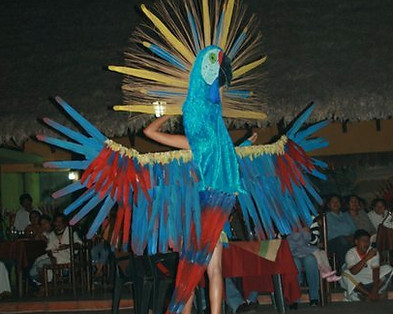
Native Bolivian tribes make ceremonial headdresses which were traditionally made from colorful bird feathers including from Blue-throated Macaws. In 2003, Armonía launched impactful education programs to promote national pride about the endemic macaw. Their alternative feather project has resulted in a dramatic decrease in real feather usage. Many native people now substitute BTM feathers with alternative feathers made from cotton cloth and palm spine.
The BTM has become the symbol of the region. In 2015, the Bolivian government designated the Blue-throated Macaw a National Heritage Species. It is now considered taboo to kill or capture Blue-throated Macaws.
© Asociación Armonía
Land Use in the Area
Cattle ranching is the main industry in much of the Blue-throated Macaw range. Over 150 years of cattle ranching in the Beni Savanna has cleared most of the large trees, reducing the availability of suitable nest areas for the Blue-throated Macaw. Besides cutting down trees for firewood and building materials, sometimes ranchers burn the savanna to produce better grass for grazing. Uncontrolled fires threaten macaw nests and prevent new trees from growing. In addition, cattle often chew young palms to the ground. Currently, most of the motacú palm trees on the forest islands are about 80 years old, with few younger trees to replace them.
Striking a balance between conservation and sustainable livestock management is key to the Blue-throated Macaw's long-term survival. In 2016, Armonía hosted the first Conference on Sustainable Cattle Ranching in the Bolivian Lowlands; the conference brought together ranchers, local stakeholders, and international conservation experts to develop sustainable beef production as a winning formula for both the local economy and the fragile ecosystem.

© Asociación Armonía
Diet
Blue-throated Macaws are highly adapted to eat fruit from large palms, most commonly the Attalea phalerata, or motacú palm, as well as the Acrocomia aculeata and Mauritia fleuxosa.

© Asociación Armonía
Identification
Locally, the BTM is called paraba barba azul, "blue-bearded macaw." Its namesake blue throat distinguishes the bird from the more common Blue-and-yellow Macaw, which is easily recognized by black feathers on its throat.
Until the 1980s and 1990s, there was significant dispute over identifying the Blue-throated Macaw species. In early descriptions of the species, it was incorrectly thought that preserved specimens of the Blue-throated Macaw might be the juvenile form of Ara ararauna, the Blue-and-yellow Macaw. The two species have overlapping habitat ranges. Once recognized as a unique species, the specimens were later reclassified Ara glaucogularis, the Blue-throated Macaw.

© Asociación Armonía
Motacu Palm Trees
The success of the Blue-throated Macaw in the wild is closely tied to the availability of motacu palm trees. Not only do cavities in mature motacu palms provide natural nesting habitat, but the fruit of this important tree is a major component of the Blue-throated Macaw diet.

© Asociación Armonía
Eco Tourism
Blue-throated Macaws can be seen in the palm islands at Asociación Armonía’s Barba Azul Reserve in northern Bolivia where the Beni savanna meets the foot of the Amazon River basin. The reserve is a safe haven for the critically endangered Blue-throated Macaw as well as a wealth of other threatened birds and mammals such as Pampa Deer, Giant Anteater, and Maned Wolf. Ecotourism is a component of the long-term sustainability plan for the BTM conservation.

© Asociación Armonía
Nesting Behavior
The Blue-throated Macaw breeding season occurs during the rainy season, November through March / April. Typically, Blue-throated Macaws nest in the empty cavities of large, mature palm trees, and females lay a clutch of two to three eggs. Chicks hatch after about four weeks and fledge after three months. After fledging, Blue-throated Macaw chicks are dependent on their parents for up to a year and become sexually mature after about five years.

© Asociación Armonía
Populations
Specimens of Blue-throated Macaws had been seen in museum collections for over a century, but without complete provenance records. The location of the wild population was not known to science until the 1990s. Listed as "endangered" in 1992, the Blue-throated Macaw status was elevated to "critically endangered" in 2000.
Although once believed to be widespread, the population was estimated at fewer than 100 individuals in 2006. Protection measures have helped boost the wild population to nearly 800 today. Since 2006, our successful Nido Adoptivo nest box project has resulted in 184 Blue-throated Macaw hatchlings that have fledged from the nest boxes. Three separate subpopulations of the Blue-throated Macaw have been identified and mapped out.
